My recent Aboriginal History review of Darrell Lewis’s A Wild History: Life and Death on the Victoria River Frontier is at:
My recent Aboriginal History review of Darrell Lewis’s A Wild History: Life and Death on the Victoria River Frontier is at:
The attached diary is of the visit that I made to China in late 1978 during a period of great change and uncertainty in that country.
Shortly after the last federal election I gave the attached talk to a meeting of the Vernon Group of the Union, University and Schools Club in Sydney. It may be of interest as another federal election approaches.
I was recently asked to write this blog for the Mosman Library. Frank Pursell was a family friend.
I gave this Anzac Day address in 2009 at a retirement village in Turramurra, a suburb in northern Sydney. I was asked to speak about my father’s experiences as a prisoner of war.
I delivered this as an after dinner speech at the ‘Beyond the Limits of Location’ seminar, Galong, New South Wales on 9 March 2013.
I have a long-standing interest in the Tennant Creek gold rush, about which I have published articles, book chapters and an occasional paper. I am considering returning to the topic. The attached short paper is based on a presentation I gave to a ‘One thousand words on a picture’ session at the 2010 Australian Historical Association conference in Perth.
Attached are the text of my self-published From Scots to Australians: The Carment and Inglis Families 1672-1976 and its back and front covers. Copies were commercially printed for some libraries and family members.
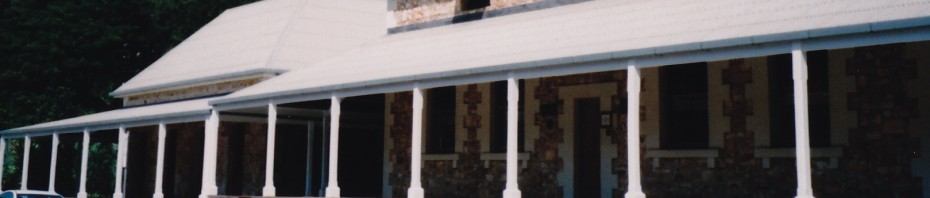
Outstanding among historic structures in Darwin, the capital city of Australia’s Northern Territory, are the former police station, courthouse, courthouse annexe and cell block. Erected in stages between the late 1870s and the late 1880s, the stone buildings with their wide verandahs were deliberately in contrast to the less substantial built environment of most of the rest of the town, which until the Commonwealth of Australia took over the Northern Territory from South Australia in 1911 was known as Palmerston. Like nearby Government House, the buildings were integral to government attempts to enforce rules of conduct. Police business and legal cases were conducted in them. In 1942, the buildings became the Royal Australian Navy’s Darwin headquarters. Very seriously damaged by Cyclone Tracy, they were derelict until 1981 when the Northern Territory Government rebuilt them as offices for the Administrator and his staff.
 dcarment